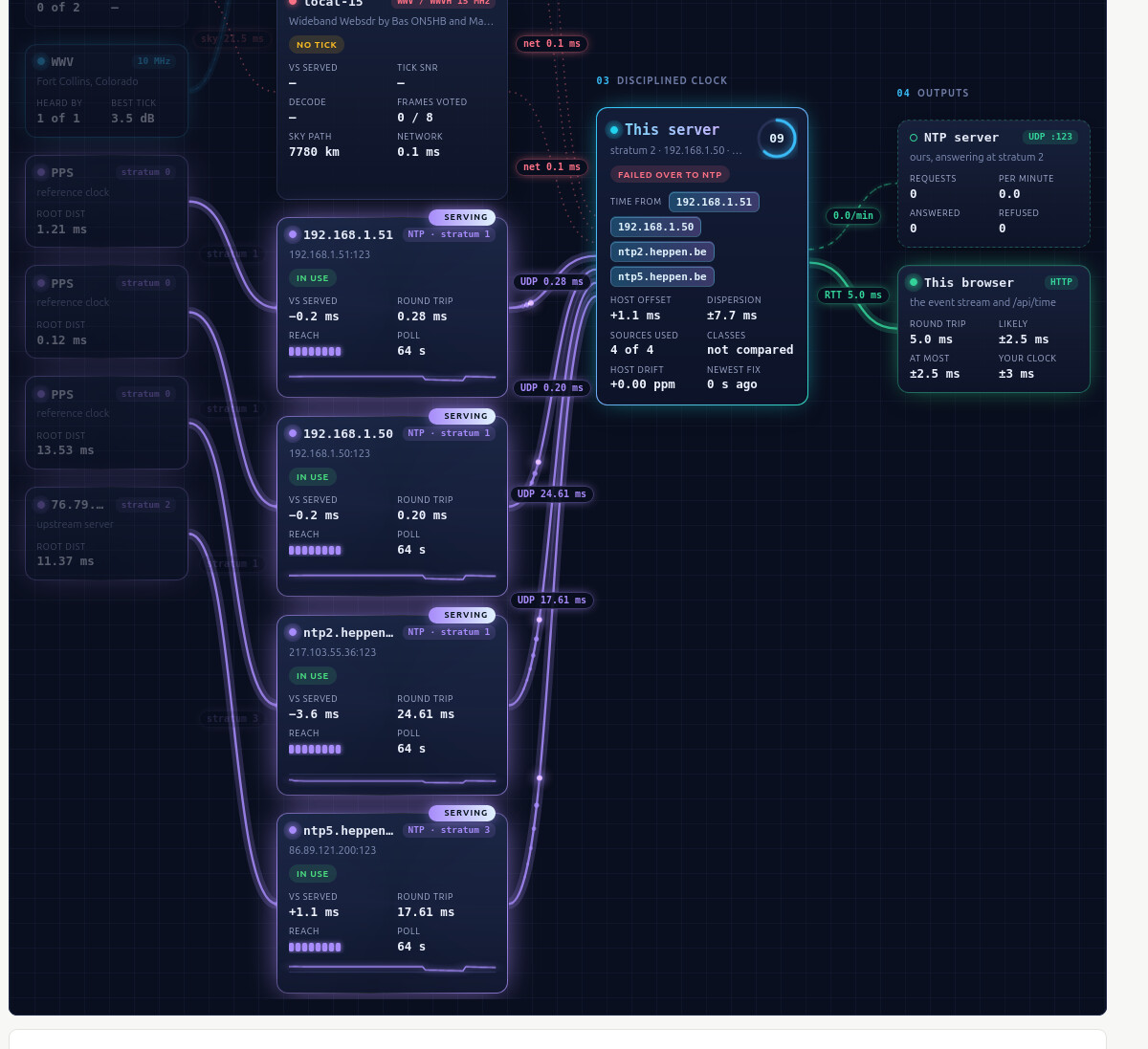
I just saw that the maker of my websdr, UberSDR, has added a nice page about NTP connections it’s using.
As it’s so nicey done, I wanted to show it with you all.
UberSDR has become better for serving time.
It now has an output for NMEA and PPS for feeding GPSD with time-data.
So you can steer GPSD to it and use Chrony or NTP to serve the Internet with time.
Also, according to the code, it can output RS-232 PPS signals at 1Hz.
Meaning, the system that uses UberSDR can be connected to another machine, using RS-232 cable to receive the 1-PPS.
My system, currently, uses 3 LW-timeservers and 2 NTP-servers as backup.
But for other parts of the world, others servers can be used. It’s not limited to these in Europe.
I’m not using this for the pool, but I might consider it.
Are there longwave (60Khz or thereabouts) times sources other than DCF77? In the US WWVB was used for time distribution until around 2012 when the modulation changed.
Does DCF77 have better in-building penetration than GNSS? I see NTP servers sync’d to DCF77 in Europe, but not elsewhere.
It would be interested to measure the offset between a DCF77 time receiver (conventional or SDR) and a GNSS device.
Yes. It’s used in alarm clocks, heating control systems, train station clocks etc. Some of those may be deep inside buildings.
Though I live in the uppermost floor of my building, with a metal roof over my head and partially around me, and my radio-controlled clocks loose sync every now and then, and I then need to place them in specific locations so they resync again.
It is said to reach somewhat reliably as far as 2,000 km (1,200 mi) from the transmitter in Mainflingen. But at that distance, there already is a multi-millisecond transmission delay, so that limits the useful range for applications with higher accuracy requirements.
Note that cheap devices, with low accuracy requirements, use the amplitude-modulated signal. Higher accuracy-receivers, such as products by Meinberg I’d assume, use the phase-modulated signal, which has a higher resolution. ntpd classic and NTPsec indicate those differences by using different reference IDs (DCFf and DCFp).
The delay is not an issue as it’s constant, remember the signal travels with the speed of light and it’s constant the same path.
It could be reflected in space, but that signal will by out of synch with the direct path, so the receiving software will count that as a mistake in time.
We are using 3 EU-LW-transmitters and 2 NTP backup’s to make sure the time is correct.
It’s not a single transmitter that is being used.
The normal range is about 2000KM for indoor devices with ferrite antenna’s, but I’m not using that.
I use a 54m longwire antenna that is build for such frequencies.
As such the range easily become 5000km or more.
You can’t compare the way we do it with a single DCF-receiver as this is a wide-spectrum-receiver that samples (in my setting) every frequency between 10KHz en 30MHz, in realtime, all the time.
So everything is known and how long it takes. This could make it very precise.
We have to figure out how good it is as nobody did this before as far as we are aware.
But there are more signals, using packet-switching, that broadcast a bunch of samples.
There are more servers, all over the world. But those can’t be used from Europe as the path isn’t direct but via reflection-layers in the sky/space, they can be used in the USA but only direct path.
They can be found on 5 / 10 / 15 MHz if I’m not mistaken. But not usable in Europe.
Direct path is ground-wave of line-of-sight, buildings don’t matter as they don’t hinder the signal.
So the direct distance is always the same, so it the delay.